
SUPPORT
HB 704 — Verifying Legal Employment Status of Workers Act
Keeping Idaho’s Workforce Legal and Leveling the Playing Field Through E-Verify
✅ Requires all registered Idaho employers to use E-Verify for new hires.
✅ Applies to private employers, public employers, and state contractors.
✅ Enforced by the Attorney General with real penalties for violations.
✅ Protects lawful workers from unfair labor competition.
✅ Aligns Idaho with proven workforce verification standards.
✅ Creates a clear, uniform statewide employment standard.
Visual Bill Tracker

Introduced by Representative Jordan Redman

Passed House Business Affairs
16-2
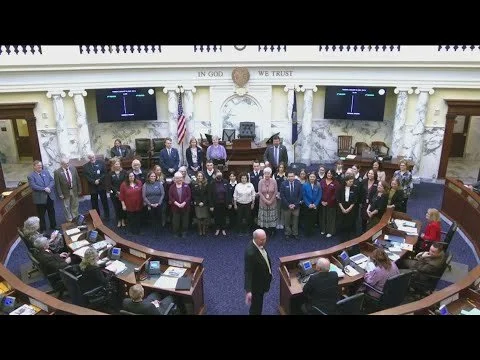
Scheduled for House Floor
Feb 27
Bill Summary
HB 704 establishes a statewide requirement that all registered employers in Idaho participate in the federal E-Verify employment eligibility verification program. The bill aims to ensure that employers hire only workers legally authorized to work in the United States by confirming eligibility through a federal database managed by USCIS.
Under the bill, employers must enroll in E-Verify and use it for every new hire. The Attorney General is tasked with enforcement authority, including issuing notices of violation and pursuing compliance actions in district court. Penalties escalate from corrective action requirements to suspension and eventual revocation of business licenses for repeated violations. Technical provisions clarify that Idaho will rely on federal determinations and will not independently adjudicate immigration status.
Impact
Establishes a uniform statewide standard for employment eligibility verification.
Reduces incentives for unauthorized employment, promoting fair competition for Idaho workers.
Offers legal certainty by aligning Idaho with existing federal verification mechanisms.
Creates clear penalties that meaningfully deter noncompliance.
Provides legislators and stakeholders with data and testimony frameworks to address common economic counterarguments.
Limitations
Relies on the federal E-Verify system; Idaho cannot independently determine immigration status.
Does not directly address related federal immigration programs (e.g., H-2A guest worker visas).
Exemptions and administrative rulemaking must be approved by the Legislature, which may limit flexibility.
Implementation may require onboarding and resources for smaller employers unfamiliar with the E-Verify process.
Position
Secure Idaho strongly supports HB 704.
HB 704 strengthens Idaho’s workforce integrity by ensuring employment eligibility checks for all registered employers. The bill aligns state law with proven verification standards used in other states, offers structured enforcement while respecting federal authority, and protects lawful workers from wage suppression and unfair competition. By mandating E-Verify statewide and providing clear enforcement consequences, the bill advances economic fairness and the rule of law without creating new federal entanglements or costly unfunded mandates.
How Secure Idaho Scored this Bill
We created a scorecard to quickly show how well each bill protects Idaho's sovereignty, jobs, families, limited government, and the freedom of Idaho citizens -priorities that match what 80% of Idahoans tell us in surveys: unchecked immigration threatens our resources, wages, and values. Yet, special interests like BigAg and the Idaho Association of Commerce & Industry (IACI) often block enforcement to prioritize cheap labor over voter priorities. Our scoring flips this by building pressure through data, tracking, and county-level mobilization ahead of the 2026 session. Here's the basic system in plain English:
1) Category Criteria and Scores: Alignment with Secure Idaho's Vision
We evaluate bills against 9 key categories that embody Idaho's core values: State Sovereignty (securing independence from federal encroachment), State Culture (protecting moral values and community cohesion), Constitutional Principles (upholding separation of powers), Government Accountability (ensuring transparency), Government Size (limiting government), Government Efficiency (fighting waste), Family Success (prioritizing families), Small Business Success (supporting the American Dream), and Individual Liberty (safeguarding personal freedoms).
For each category, we ask targeted sub-questions based on bill text, data, and potential impacts:
Does it strengthen/enhance/improve the goal? → +1 point
Does it diminish/undermine/hurt the goal? → -1 point
Neutral or no effect? → 0 points
We average the sub-questions per category (equal weighting), then sum the 9 averages for an Overall Raw score (-9 to +9). This is converted to a 0–100 Secure Idaho Alignment Score: (Raw + 9) ÷ 18 × 100. Higher scores mean stronger alignment with protecting Idaho from unchecked immigration strains.
2) Impact Rating: The 5 Levels of Real-World Effect
Beyond alignment, we rate the bill's potential impact on a 1–5 scale, considering scope (statewide vs. limited), enforcement (penalties vs. voluntary), projected effects (e.g., reducing job/housing/welfare strains per data), blockability (vulnerable to BigAg amendments/exemptions), and precedent.
1: Symbolic/Minimal (e.g., resolutions, studies - no enforcement; limited to one program/county; no teeth; easily blocked; minimal precedent). Low pressure on special interests.
2: Narrow/Limited (e.g., one-sector restrictions; easy exemptions; voluntary compliance; some data tracking but weak follow-through; moderate block risk). Incremental but not transformative.
3: Moderate (e.g., partial mandates with penalties; metrics for review; affects multiple sectors but with gaps; builds some precedent; medium risk of weakening). Builds momentum for county mobilization.
4: Significant (e.g., statewide mandates with real penalties; direct protections for jobs/resources; hard to exempt; strong data-driven effects; counters BigAg influence). High advocacy value.
5: Transformative (e.g., full E-Verify/sanctuary bans; blocks federal/H-2A overreach systemically; robust enforcement; statewide scope; sets major precedent for 2026 flips). Game-changer for sovereignty.
This rating ensures we prioritize bills with teeth over feel-good measures.
3) Bill Tier: How Alignment + Impact Determine Priority and Legislator Impact
We combine the Alignment Score (0–100) and Impact Rating (1–5) to assign a Tier (1–3), which sets a multiplier for how much the bill affects legislator scores on our dashboard. Higher alignment + higher impact = higher tier. For example: Strong alignment (80+) with transformative impact (5) might earn Tier 1; moderate alignment (50–69) with narrow impact (2) might be Tier 3.
Tier 1 (Multiplier: 4x – High Impact): Top priority—strong alignment, significant/transformative effects. These bills (e.g., mandatory E-Verify) heavily influence legislator scores; supporting them boosts a rep's grade, while blocking tanks it. We rally hard (petitions, rallies, county task force posts).
Tier 2 (Multiplier: 2.5x – Medium Impact): Solid alignment, moderate/significant effects. Worth backing but monitored for amendments (e.g., sanctuary bans). Medium weight on scores—encourages flips without overwhelming.
Tier 3 (Multiplier: 1.5x – Limited Impact): Weaker alignment or lower impact (e.g., studies or partial restrictions). Low weight on legislator scores—doesn't make or break a grade but tracks patterns (e.g., repeated BigAg ties). We watch/expose rather than lead advocacy.
Tier 4 (1x multiplier – Minimal Impact): Low alignment + symbolic/narrow impact. Mostly feel-good or toothless measures that don’t meaningfully protect Idahoans from immigration strains. Minimal or no weight on legislator scores - we note them for patterns but focus energy elsewhere (e.g., stronger bills).
Why tiers matter: They ensure high-stakes bills count more toward legislator accountability. A vote on a Tier 1 bill could swing a score by 40–80 points; Tier 3 by just 15–30. This pressures reps to prioritize voter demands over lobby donors (see our Follow the Money dashboard for BigAg PAC ties).
HB 704 scores 79 because it establishes a universal, statewide E-Verify mandate with enforceable penalties that materially change employer incentives and labor market behavior. Unlike prior limited proposals, HB 704 applies to all registered employers in Idaho, including public entities, private businesses, contractors, and subcontractors. The bill requires enrollment in and use of the federal E-Verify system for all new hires and grants enforcement authority to the Attorney General. Escalating penalties - including probation, suspension, and permanent revocation of business licenses for repeat violations - create meaningful consequences for noncompliance.
HB 704 goes beyond symbolic enforcement by establishing structural accountability. Immigration status determinations must come from the federal government, preventing independent state adjudication while ensuring compliance relies on verified federal findings. The bill includes clear definitions, good-faith compliance defenses, and court-directed remedies, creating a predictable and enforceable framework. By mandating universal participation and attaching real penalties, HB 704 removes the economic incentive to hire unauthorized labor and levels the playing field for lawful employers and workers statewide.
While the bill does not address sanctuary policies, public benefits eligibility, or federal visa programs, it targets the primary economic driver of illegal employment: unauthorized hiring. As a result, HB 704 represents a structural shift in Idaho’s employment enforcement landscape.
Impact Rating = 5 (Transformative). Tier = 1 (4× multiplier).
Want the full breakdown? Scroll down for the category table (every sub-question, score, average), impact notes, and tier rationale.