
BigAg's Doomsday Scenario Debunked: Arizona Proved E-Verify Works
The Idaho Alliance for a Legal Workforce (IALW), a lobbying coalition backed by major dairy producers, construction firms, and related Big Ag interests, just released their February 2026 report, *The Story of Idaho Labor Markets: An Economic Analysis of Foreign-Born Contributions*.
They claim that enforcing immigration laws (including mandatory E-Verify) would slash Idaho’s Gross State Product by up to 5%, triggering a “self-inflicted Great Recession.”
That’s catastrophic framing designed to scare lawmakers and the public into preserving the status quo of cheap foreign labor.
I read the full 40 page document. Here’s what it actually is.
The Idaho Alliance for a Legal Workforce's February 2026 report, sponsored by dairy and construction interests reliant on foreign-born labor. Claims enforcement would trigger recession.
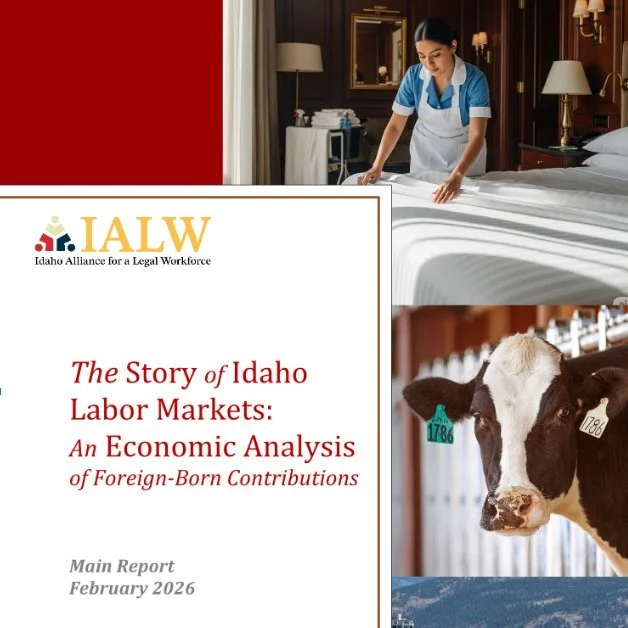
The Idaho Alliance for a Legal Workforce's February 2026 report, sponsored by dairy and construction interests reliant on foreign-born labor. Claims enforcement would trigger recession.
Not a Neutral Forecast. It's Commissioned Lobby Analysis.
This is not a peer-reviewed macroeconomic forecast from neutral academics. It is a commissioned Input-Output (I-O) impact model, funded and sponsored by the very industries whose profit margins depend heavily on illegal and low-wage foreign-born workers.
When the people who benefit most from the current labor structure pay for a study warning that changing it will cause economic collapse, the incentive structure matters. These same groups have historically lobbied against E-Verify mandates and other enforcement measures in past Idaho sessions, prioritizing cheap labor over voter priorities.
The Limits of Static I-O Models
I-O models are useful for tracing supply-chain ripples, but they are static. They assume that if labor suddenly drops, output drops mechanically, and the shock cascades through the economy like dominoes, without any meaningful adaptation.
What this model deliberately excludes:
❌ Wage increases that attract domestic workers (Idaho’s unemployment remains low; plenty of Idahoans would step up if pay reflected the true market) ❌ Capital investment, automation, and productivity improvements (dairies and farms could modernize rather than rely on exploited labor) ❌ Interstate labor mobility and workforce participation changes ❌ Business restructuring or shifts to legal guest-worker programs done right ❌ Long-term market equilibrium and economic resilience
In short: it models short-term panic and disruption, not how real economies actually respond.
Real-World Proof: Arizona's Experience with Mandatory E-Verify
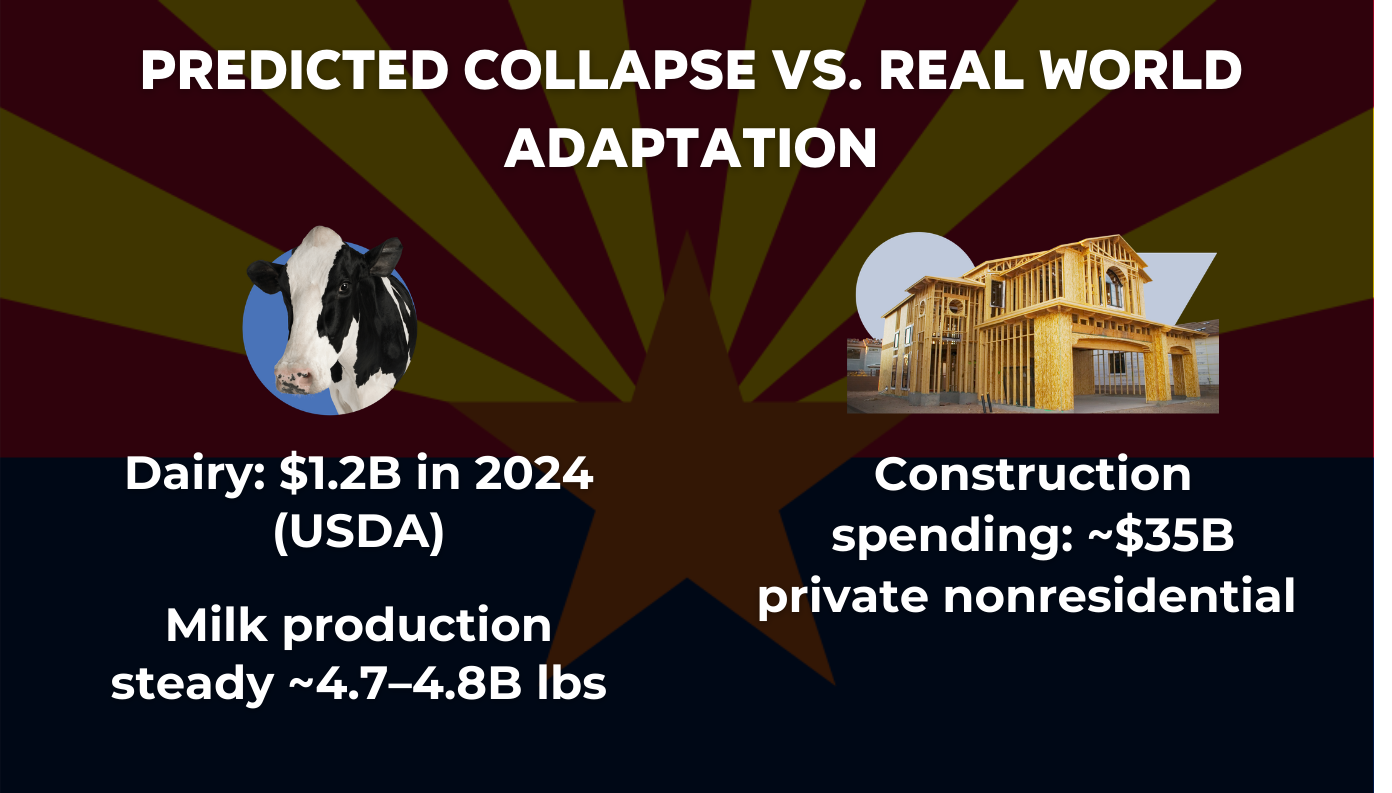
Arizona dairy & construction post-E-Verify: Thriving. $1.2B dairy, $35B construction boom. No collapse. Just adaptation. Idaho next
We have clear real-world evidence that adaptation happens and sectors grow stronger. Look at Arizona.
Arizona dairy & construction post-E-Verify: Thriving. $1.2B dairy, $35B construction boom. No collapse. Just adaptation. Idaho next
When Arizona passed the Legal Arizona Workers Act (LAWA) and mandated E-Verify statewide starting in 2008, critics and industry groups issued nearly identical warnings: “dairy will collapse”, “construction will crater”, the economy will suffer massive losses.”
What actually happened?
Arizona’s dairy industry did not implode. By 2024, dairy was Arizona’s top agricultural commodity by cash receipts at roughly $1.2 billion (USDA data). Milk production has remained stable in the 4.7 to 4.8 billion pound range annually in recent years. Family dairies continue to supply the overwhelming majority of in-state milk. The sector adjusted through higher wages, technology adoption, and legal workforce channels. And emerged stronger.
Construction told the same story. Far from contracting permanently, Arizona’s construction industry expanded significantly post-mandate. In 2024, private nonresidential construction spending alone reached approximately $35 billion (AGC data), with the overall construction sector contributing about $37 billion (6.4%) to Arizona’s GDP. It scaled alongside population and housing demand. No Great Recession repeat. No permanent collapse. Just adaptation and growth.
Arizona faced the same “end of agriculture as we know it” scare tactics that IALW is now running in Idaho. The predictions were wrong then. They’re wrong now.
IALW's Scenario Relies on Cherry-Picked Assumptions
IALW’s doomsday scenario rests on a stack of cherry-picked assumptions:
🍒 90% foreign-born dairy labor (widely cited but including legal workers), with 45% production loss assuming ~50% undocumented exit. This ignores legal retention via H-2A or wages. 🍒 Roughly 70% of undocumented workers (~35,000–40,000 total in Idaho) exiting the state 🍒 13% contraction in residential construction 🍒 10% contraction in hospitality & dining
Those are not forecasts. Those are scenario inputs. Change the assumptions, and the “Great Recession” narrative collapses.
The report itself admits it is limited to the “immediate term”, where businesses supposedly cannot adapt quickly enough and must curtail output. Yet it still invokes one of the worst macroeconomic crises in modern U.S. history for headline impact.
That’s not dynamic economic modeling. That’s headline engineering.
The Other Side of the Ledger: Net Fiscal Costs and Voter Sentiment
Meanwhile, the model conveniently ignores the other side of the ledger: According to FAIR’s state level fiscal estimates, illegal immigration imposes a net fiscal burden on Idaho well beyond the ~$72 million in taxes contributed. This includes costs in public services, education, healthcare, and infrastructure that exceed revenues (net ~$405 million burden in recent analyses). Meanwhile, Rasmussen polling shows over 80% of Americans view unchecked illegal immigration as harmful to jobs and public resources.
Yes, abrupt enforcement could create short-term transition costs in certain sectors. No serious person denies that.
But claiming that lawfully enforcing hiring rules would automatically crater Idaho’s entire economy assumes markets cannot respond, wages won’t rise, capital won’t shift, industries won’t innovate, and Idahoans won’t fill the gaps.
Arizona proves otherwise.
Idaho is one of the fastest-growing states in the nation, with low unemployment, strong construction activity, and a resilient economy. We don’t need lobby-funded static shock simulations dressed up as inevitability. We need real world evidence, dynamic analysis, and policies that put Idaho families first.
Mandatory E-Verify works. Enforcement works. Adaptation works. Arizona shows the path.
Sovereignty and accountability must come before special interest profits. Idahoans first.
